

How To Make Ice Crystal Makeup
Exotic crystals of 'ice 19' discovered
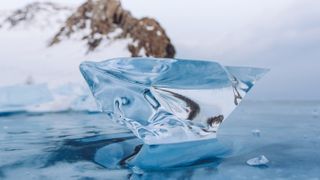
Scientists have identified the 19th class of water ice. The exotic, four-sided crystals of this rare ice multifariousness, now dubbed ice Nineteen, course at ultra-depression temperatures and ultra-loftier pressures.
Information technology only exists in laboratory experiments, but researchers say information technology reveals more nigh other forms of ice, which tin exist found deep in the Earth's drapery and on very common cold planets and moons.
"To name a new ice form, one needs to elucidate exactly what the crystal construction is," said lead researcher Thomas Loerting, a professor of physical chemistry at the University of Innsbruck in Austria. That ways figuring out the simplest repeating structure of the crystal, where all of the atoms are located inside that structure, and what the symmetry of the crystal construction is, Loerting said.
"Only if all of these are known, you lot are allowed to name your ice … Ice Nineteen is at present the proper name for the new water ice phase discovered in our work," he told Live Science in an email.
An commodity by Loerting and his colleagues describing the new course of water ice was published Feb. xviii in the periodical Nature Communications, alongside a study by researchers in Nippon who verified the discovery.
Related: Snowflake gallery: No two alike, of course
A new water ice
Nigh anybody is familiar with the beautiful six-sided diverseness of snowflakes, which mirrors the hexagonal arrangement of oxygen atoms in the crystals of h2o water ice that make them.
But regular six-sided crystals of ice — ice I — are actually just one of its many forms, which are known as polymorphs. And until recently, 18 dissimilar polymorphs of h2o ice had been formally identified — although simply half dozen-sided ice is common on Earth.Although ice might seem simple, it is complicated stuff. For case, simply the oxygen atoms in the h2o molecules of six-sided water ice crystals form a hexagonal shape, while their hydrogen atoms are randomly oriented around them. This makes ice I a "disordered" or "frustrated" ice in the terminology of ices. One of the backdrop of such disordered ices is that they can deform under force per unit area: "This is the reason why glaciers flow," Loerting said.
In contrast, the hydrogen atoms in several of the other polymorphs of ice as well accept their own crystal patterns, and they are chosen "hydrogen-ordered" or "H-ordered" as a result. Unlike disordered ices, H-ordered ices are very breakable and will shatter, rather than deform, he said.
In those terms, the newly identified 19th grade of water ice is an H-ordered water ice; in fact, it's an H-ordered class of a disordered water ice, called ice Half dozen, which has a random pattern of hydrogen atoms. And ice Half dozen also has yet another H-ordered polymorph, ice Fifteen, in which the hydrogen atoms are aligned in an entirely dissimilar pattern.
"Ice VI, ice 15 and ice XIX are all very similar in terms of density [considering] they share the same kind of network of oxygen atoms," Loerting said. "But they differ in terms of the positions of hydrogen atoms." It's the showtime time that such a human relationship between ice polymorphs has been discovered, and information technology could permit experiments to written report transitions between one form and another, he said.
Crystal structure
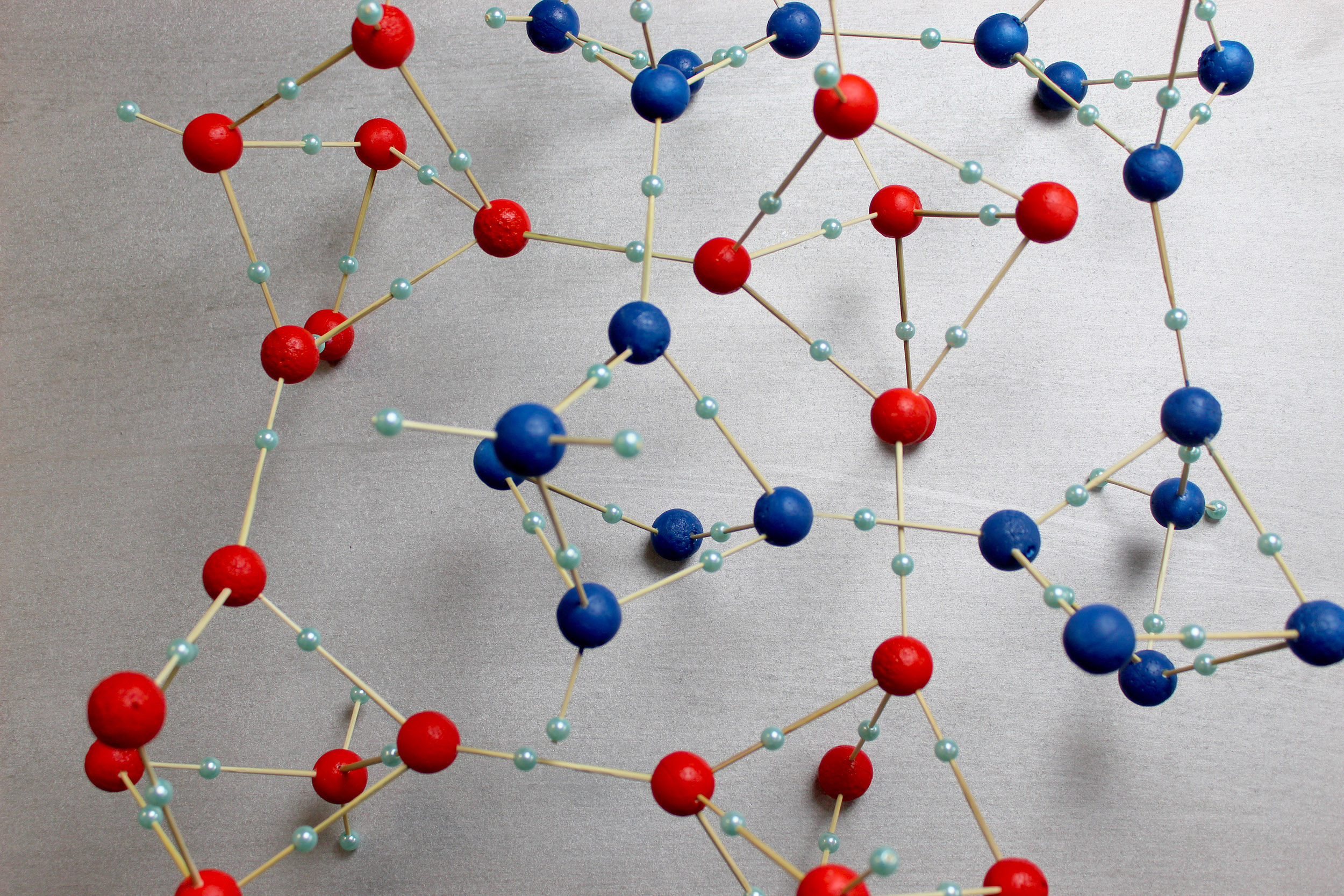
Loerting's team first made ice Nineteen in their laboratory experiments three years agone, by slowing the cooling process of ice XV to about minus 170 degrees Celsius (minus 274 degrees Fahrenheit) and greatly increasing the pressure to roughly ii gigapascals. Merely the details of its crystal structure eluded them until they were able to study it with a procedure called neutron diffraction, which can reveal the atomic structure of a material by bouncing a stream of neutrons off information technology and examining the resulting diffraction design.
In normal circumstances, neutron diffraction requires swapping out the water in a sample with heavy h2o that contains extra neutrons. Just pure heavy water was impractical for the ice Nineteen experiments because it freezes much more than slowly, Loerting said. The quantum was to dose the heavy water with a fraction of regular light water, producing water that froze quickly simply still allowed neutron diffraction.
Loerting explained that the structure of water ice is a key to the nature of the hydrogen bond, which is imperfectly understood. It'due south also of import for understanding angelic bodies, such as the ice giants Uranus and Neptune and icy moons of Jupiter (including Europa, Io and Ganymede), where another ice polymorphs are found.
"It is of smashing interest in astrophysics to know the density and the backdrop of the ice phases, to exist able to understand the beliefs of the icy mantles or icy cores of these celestial bodies," he said.
And there are all the same many more than polymorphs of ice out there. The discovery of ice Xix makes six ice polymorphs discovered at the University of Innsbruck since the 1980s, and Loerting hopes his team will notice the next one, too. "The race for ice XX started yesterday, and I hope my research group will be the one to publish information technology," he said.
"Originally published on Alive Science.
Source: https://www.livescience.com/exotic-ice-19-discovered.html
Posted by: shortridgeginee1985.blogspot.com
0 Response to "How To Make Ice Crystal Makeup"
Post a Comment